


The Economics of AI Training: Why Legacy is Left Behind
We are currently overwhelmed with new AI models reaching “inhuman” results in software coding competitions and modern development tasks. However, there is a silent truth in the AI industry: while billions are spent on training models to write Python, Java, or React, the investment in legacy technologies is nearly non-existent.
To understand why your mission-critical system isn’t getting the AI attention it deserves, we need to look at the “missing links” in the AI training cycle: Data and Reinforcement Learning (RL).
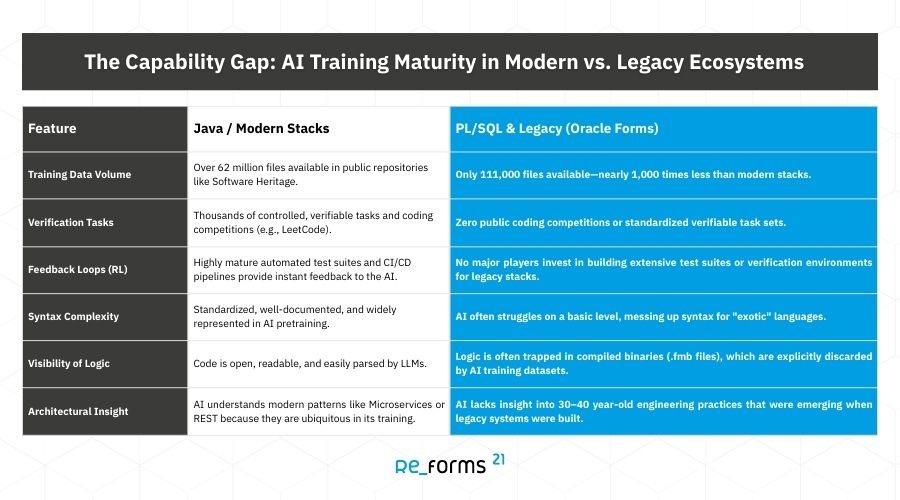
The Data Desert: You Can’t Train on What You Can’t See
Most successful AI systems require a very solid set of coding examples in a specific technology to reach professional proficiency.
For modern stacks, the data is abundant. But for legacy systems, the public domain is a desert:
- Zero Binary Visibility: AI training datasets (like Software Heritage) explicitly discard binary files—the very format where most Oracle Forms (.fmb) logic resides.
- Statistical Invisibility: In major coding corpora, SQL has a 10x smaller presence than JavaScript or Python, and PL/SQL is just a tiny fraction of that subset.
- Legacy technologies have 1000 times less training data than modern software stacks.
The Reinforcement Learning (RL) Gap
True AI mastery in coding comes from Reinforcement Learning—optimizing models against thousands of controlled and verifiable tasks.
The problem? No big player is investing in building extensive test suites and verification environments for technologies like Oracle Forms or COBOL. It is simply too expensive to find and hire experts in these narrow fields to “teach” the AI what constitutes “good” legacy code. Without these feedback loops, AI systems struggle with basic syntax for exotic languages and lack the architectural insight required for a safe migration.
The Planning Problem: AI Lacks a “Long Game”
Modernization is not a single code-snippet task; it is a structured plan with thousands of steps leading to a single goal.
Current AI systems are largely incapable of executing such long-term, complex plans. They excel at “smoothing the edges” of 60-70% of the code, but they fail to capture the deep business rules and 30-40-year-old engineering practices that were only emerging when these systems were built.
ReForms21: Bridging the Expertise Gap
Because the AI industry has ignored the legacy sector, the “AI-only” approach to modernization is still firmly in the “promise” section.
At ReForms21, we bridge this gap by combining our extensive expertise with a structural engineering approach. We don’t rely on general-purpose AI that has never seen a .fmb file. Instead, we:
- Build a technical and operational model of your system.
- Use iterative mapping to construct high-confidence business process maps based on evidence, not probabilistic guesses.
Conclusion: Engineering Over Hope
The “missing link” in AI training means that for legacy systems, AI is a reality for supporting tasks and knowledge extraction—but not for automated, high-fidelity code conversion.
If you want a modernization project that respects your complex business rules, you cannot wait for the AI giants to catch up. You need a partner who has spent years mastering the technologies that the AI models simply ignored.


