

Most legacy modernization projects don’t fail because of bad intentions. They fail because of a dangerous assumption: that AI can automatically fill in the gaps.
I call it the Hybrid Trap—and it is quietly killing enterprise modernization programs right now.
The pattern usually looks like this: The team manually rebuilds the target architecture, then hands the migrated code to an AI tool to “clean things up.” The result looks polished. Demos go well. Executives approve the next budget phase.
Then production happens.
What Nobody Talks About at the Board Level
The parts AI “smooths over” are not cosmetic. Those exact edges are where e.g. 30 years of critical business rules are hiding—constraints, triggers, and operational logic that nobody ever wrote down because it was never supposed to move.
General-purpose AI models are statistically unlikely to see any of it. Why? Because the training data for your specific system simply doesn’t exist. See the example:
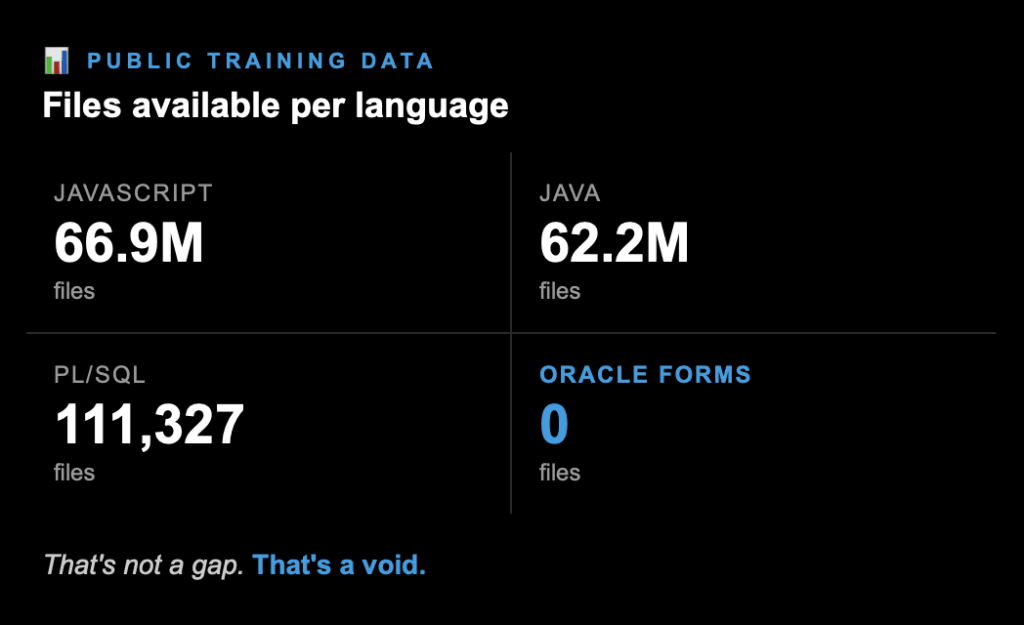
On top of that, in this case most Oracle Forms logic lives in compiled binary files (like .fmb), which major coding datasets explicitly discard. The AI hasn’t just seen less of your system—it has never seen anything like it.
What happens when you ask a probabilistic model to interpret something it has never been trained on?
It guesses.
It produces syntax that looks plausible and generates logic that appears functional. In a modern Java codebase, you would catch these errors quickly. But in a 30-year-old legacy system with no regression suite, where institutional knowledge is locked in the heads of three engineers about to retire—you won’t catch it until it costs you something serious.
The executive risk technical teams struggle to articulate: Modernization done this way doesn’t reduce technical debt. It launders it !
A SAFER PATH: Engineering Certainty Over AI Guesses
The answer is not to abandon AI. The key is to use AI where it is genuinely strong, and replace it with engineering certainty where it isn’t.
The ReML suite was developed to address a critical gap in legacy modernization: engineering teams frequently lack clear visibility into their systems because they are relying on generic tools built for entirely different software paradigms. The core philosophy behind the ReML suite is simple: legacy systems require specialized, deterministic understanding, yet teams are often forced to approach them with modernization tools built for a completely different set of challenges.
ReML includes two instruments worth understanding if you are running or planning a legacy modernization program:
1. RIB — Re_Forms21 Information Base
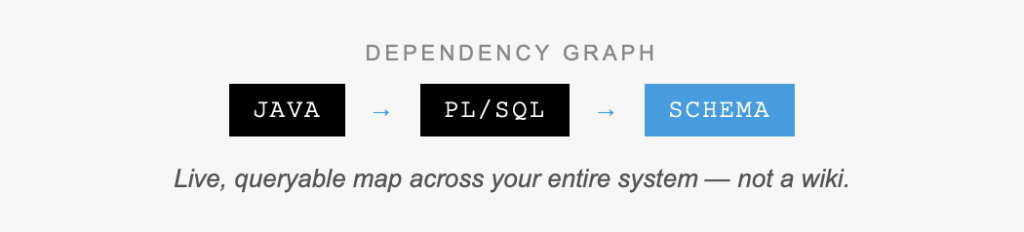
Before you refactor anything, you need to know what you are actually dealing with. RIB ingests your Java/React source, PL/SQL, Oracle schemas, and UI metadata, then builds a precise, queryable dependency map across your entire system.
This is not a static diagram or a wiki page. It is a live, structural graph that tells you exactly what breaks before you touch it.
- Dependency Chains: Cut analysis time from days to minutes.
- Developer Onboarding: Reduce new developer ramp time from 3–6 months to days.
- Real Context for AI: Feed tools like Cursor or Claude Code with actual system context instead of generic guesses.
2. RTA — Re_Forms21 Test Assistant
Once you start moving, how do you prove nothing broke? This is the question most migration teams cannot answer honestly.
RTA records real user executions in your INT/UAT environments, converts them into automated Playwright regression tests, and generates Gherkin documentation that QA leads, BAs, and developers can all actually read.
- Automated Regression: Turn one real user flow into a full regression test automatically.
- Behavior-Driven Documentation: Generate business flow documentation directly from observed runtime behavior.
- Zero-Risk Releases: Drop release risk from “unknown until production” to verified before every single deployment.
Both tools connect to your existing environment in a single session. No codebase changes required. No infrastructure setup.
The Bottom Line for Leaders
If your modernization roadmap includes legacy environments like Oracle Forms, PL/SQL, Delphi, or any 4GL system built before 2005, the question is not whether AI can help.
The question is: Do you know exactly where AI stops being reliable, and what replaces it at that boundary?
The teams getting modernization right are not the ones with the biggest AI budgets. They are the ones who treat legacy migration as a structural engineering problem—not a code generation task.


