
Oracle Forms to React Migration.
Modern Frontend.
Proven Logic.
Stop risking manual rewrites of mission-critical systems. ReForms21’s automated transformation approach moves Oracle Forms applications to React while preserving the behavioral integrity your operations depend on.
Trigger-aware migration architecture
Automated PL/SQL → Java/React transformation
Server-Driven UI with real-time SSE sync
The Real Migration Risk
Is Not the Interface.
Every Oracle Forms system has two layers. One is visible. One is not. The one that matters most is the one that fails silently during a manual migration.
Oracle Forms applications carry a precisely ordered system of triggers – 120+ or more event types that define how the application responds to user actions, database events, record validation, and query execution. These triggers fire in sequence, depend on each other, and encode years of business rules that were never formally documented.
When a migration project replicates this layer manually, it makes hundreds of interpretation decisions about behavior that nobody wrote down. Each one is a potential gap. Each gap is a potential production incident — one that survives initial testing and surfaces only when real users hit edge cases months after go-live.
Oracle Forms — Trigger Architecture Surface (120+ event types)
What Goes Wrong in Manual Rewrites
Recurring failure patterns observed across Oracle Forms migration projects that rely on manual logic reconstruction.
Trigger Firing Order Misinterpreted
Trigger sequencing is assumed rather than mapped. Silent validation failures occur when PRE and WHEN triggers are reordered or consolidated.
WHEN-VALIDATE-ITEM Logic Lost
Field-level validation rules are merged or omitted. Business rules that prevent invalid data from reaching the database are silently dropped.
Pre/Post-Query Behavior Missing
Query modification logic applied in PRE-QUERY triggers is not reproduced, causing incorrect data retrieval in complex filtered query scenarios.
Stateful Lifecycle Not Reproduced
Oracle Forms' server-managed application state is replaced with client-side state management, leading to session and navigation inconsistencies.
Automated Transformation. Not Manual Rewriting.
ReForms21 does not ask a development team to interpret your trigger logic. It analyzes it, maps it, and transforms it automatically — preserving behavioral integrity at the architecture level.
01
Analysis & Trigger
Mapping
Automated extraction of Oracle Forms structure, complete trigger inventory, and event dependency mapping. Produces a precise behavioral model of the application before any transformation begins.
02
PL/SQL → Java Transformation
Automated conversion of trigger logic from PL/SQL into Java. Trigger hierarchy, event sequencing, and validation rules are preserved in the transformation output — not reinterpreted.
03
React Frontend
via SDUI
React components are generated and synchronized with the Java backend through a Server-Driven UI architecture. UI layout and behavior are driven by server state, preserving Oracle Forms' event-reactive model.
04
Behavioral
Validation
Equivalence testing validates that the migrated application produces the same behavioral outputs as the Oracle Forms source across defined scenarios. Regression scope is bounded by the transformation model.
Automated Transformation. Not Manual Rewriting.
Every manual decision in a migration is a potential interpretation error. Automated transformation eliminates interpretation from the logic layer. The behavioral model is derived from the source application, not reconstructed from documentation that may be incomplete, outdated, or absent. The result is a migration where regression testing validates equivalence — not reconstruction.
Modern Interface. Same Business Behavior.
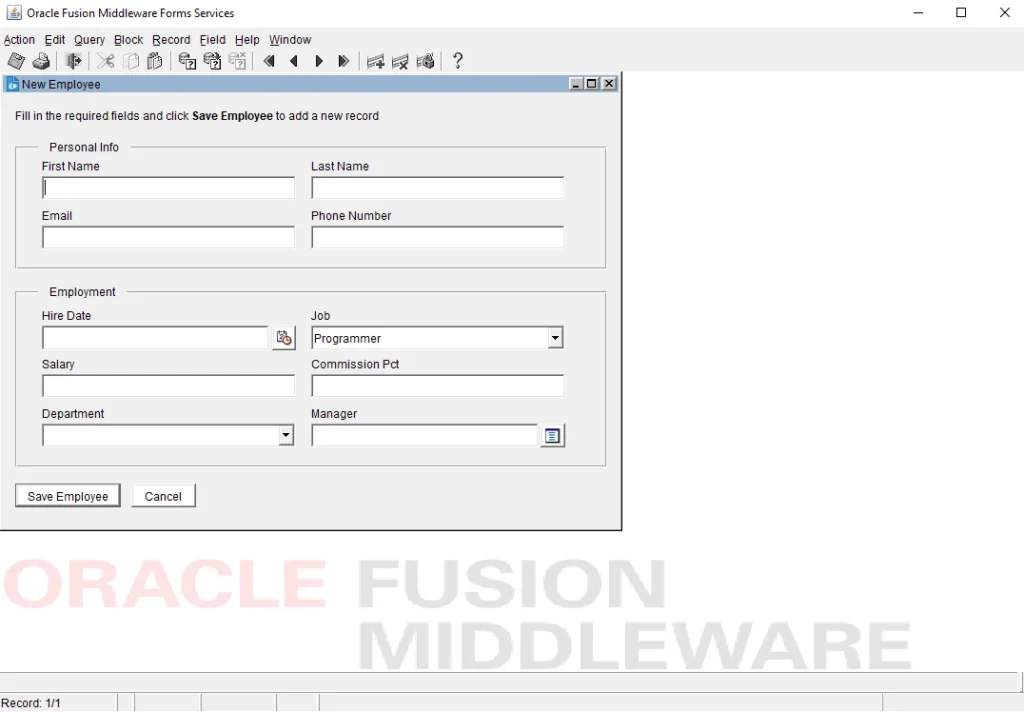
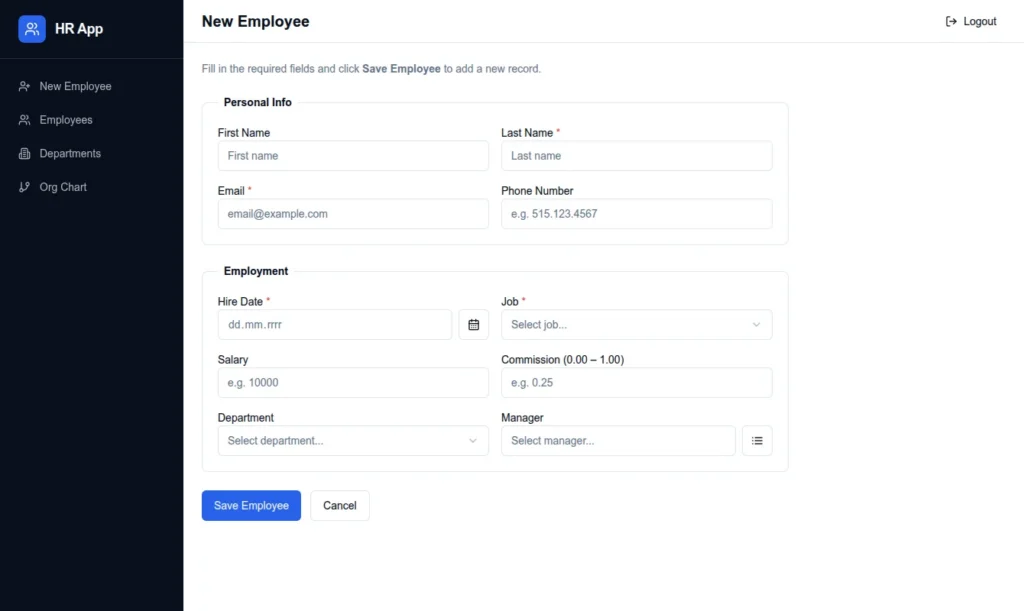
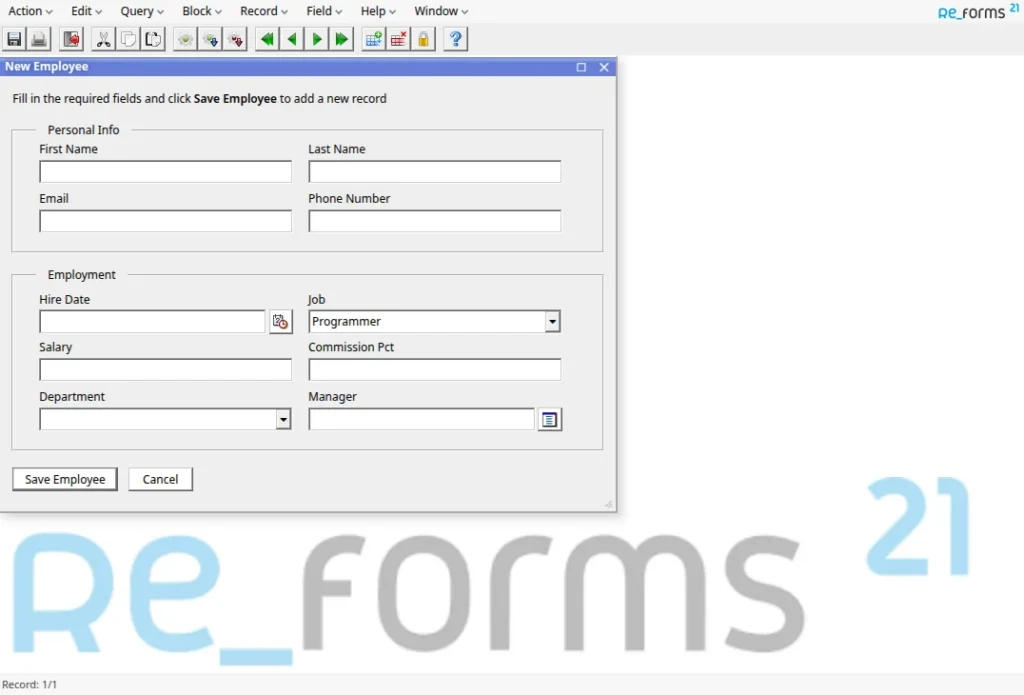
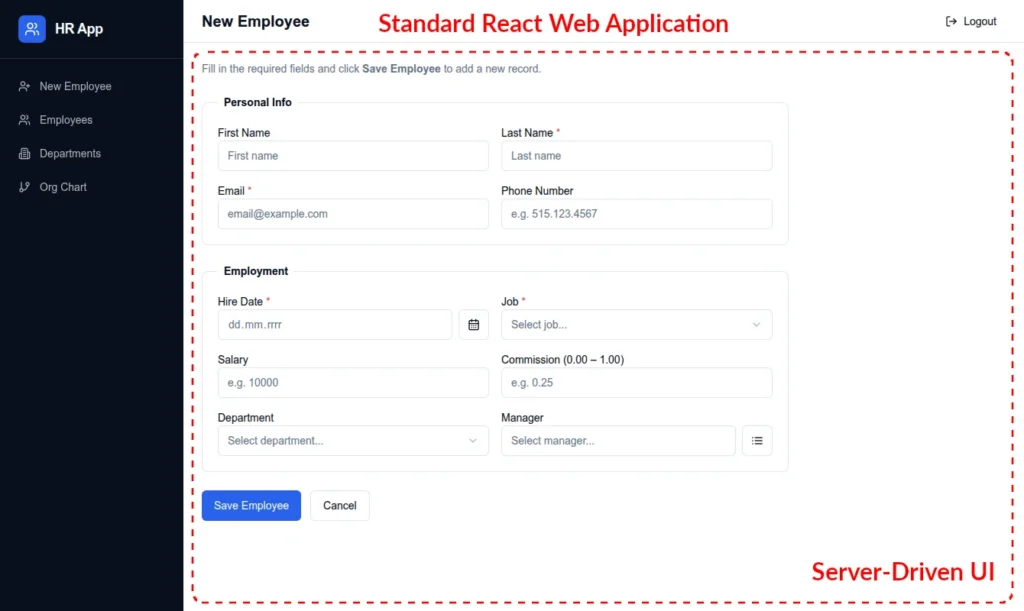
The interface changes. The logic does not. Drag the slider to compare the actual Oracle Forms Fusion Middleware interface (left) with the same form running in SDUI React with Java backend (right). The behavioral equivalence callouts below show what is preserved — not just what looks different.
Before — Legacy Oracle Forms (Oracle Fusion Middleware)
After — SDUI React with Java Backend
React Is Not a Trend Here. It Is an Architectural Decision.
The choice of React is based on structural compatibility with Oracle Forms’ event-driven, server-stateful model — not on framework popularity.
Component Architecture Maps to Oracle Forms' Block Model
Oracle Forms organizes elements into blocks and items with defined relationships and event scopes. React's component model provides a structurally compatible abstraction that preserves this hierarchy in a maintainable, modern form.
Server-Driven UI Compatibility
React's rendering model supports the SDUI pattern cleanly — UI layout and state driven by server responses, not by client-side logic. This is a natural fit for Oracle Forms' server-dependent behavior model.
Real-Time State Synchronization via SSE
Server-Sent Events provide a lightweight, reliable mechanism for pushing state changes from the Java backend to the React frontend in real time — replacing Oracle Forms' synchronous client-server communication with a modern, scalable equivalent.
Ecosystem Maturity & Long-Term Supportability
React has demonstrated long-term platform stability with deep enterprise tooling, testing infrastructure, and talent availability. A migration to React is a migration to a technology that enterprise teams can own, maintain, and extend independently.
React + Java + SSE: An Enterprise-Ready Modernization Architecture.
Designed from the ground up to preserve Oracle Forms’ stateful, event-driven runtime in a modern, production-grade stack. Every layer has a purpose.
LAYER 1 – SOURCE
Oracle Forms Application
.fmb source files · PL/SQL trigger logic · 120+ trigger types · Database integration · Stateful lifecycle
Layer 2 — Transformation
ReForms21 Automated Transformation Engine
Trigger extraction · Behavioral model construction · Automated PL/SQL → Java conversion · Trigger hierarchy preservation
Layer 3 — Runtime
Java Backend — Business Logic & State Manager
Trigger extraction · Behavioral model construction · Automated PL/SQL → Java conversion · Trigger hierarchy preservation
Layer 4 — Communication
Server-Sent Events (SSE) — Real-Time State Channel
Persistent connection · Real-time state push · Event-driven updates · Replaces synchronous Oracle Forms client-server protocol
Layer 5 — Presentation
React Frontend — Server-Driven UI
Component-based · State received via SSE · No business logic client-side · Responsive & accessible · Cloud-deployable · Containerizable
Stateful behavior managed server-side, as in Oracle Forms runtime
Event sequencing preserved in the Java trigger model
React layer decoupled from business logic entirely
Database integration maintained from source application
Cloud-deployable and containerizable without logic changes
Enterprise authentication and session management at Java layer
Choose the Migration Path That Fits Your Organization.
Not every Oracle Forms migration has the same scope, timeline, or risk tolerance. ReForms21 supports two structured paths — both architecturally sound, both trigger-aware.

PATH 1
Full React Modernization
Best for: Organizations ready to replace the Oracle Forms frontend entirely with a modern React application and retire the Oracle Forms runtime.
- Complete UI modernization and user experience improvement
- Full elimination of Oracle Forms runtime dependency
- Maximum long-term maintainability and team ownership
- Clean architectural separation of UI and business logic
- Modern deployment: cloud-ready, containerizable
Plan For
Full application scope assessment required before cutover. Structured testing, equivalence validation, and a parallel-run period recommended for mission-critical systems.
PATH 2
Hybrid SDUI Embedding
Best for: Organizations that need to modernize incrementally, cannot execute a full cutover, or need specific Oracle Forms modules modernized before others.
- Lower initial risk and organizational commitment
- Phased modernization aligned with business priorities
- Validate the migration approach on lower-risk modules first
- No forced big-bang cutover — controlled, measurable pace
- Proven architectural path to full migration when ready
Plan For
Coexistence period requires careful state management between legacy and modern components. Integration boundary between Oracle Forms and SDUI must be clearly defined upfront.
Not sure which path fits your Oracle Forms environment? Our migration assessment maps your application’s trigger inventory, module complexity, and organizational constraints, then recommends the right starting point. There is no commitment involved.
The interface changes. The logic does not. Drag the slider to compare. The behavioral equivalence callouts below show what is preserved, not just what looks different.
WHEN-VALIDATE-ITEM
Preserved as a Java event handler, firing at the same point in the interaction sequence as in Oracle Forms. Field-level validation rules remain intact.
PRE-QUERY / POST-QUERY
Query modification logic maintained in the backend event chain. The same filtering and data retrieval behavior the application has always used.
WHEN-NEW-RECORD-INSTANCE
Reproduced through SSE state push, triggering the React frontend to update at the equivalent lifecycle moment — preserving navigation behavior.
POST-CHANGE / KEY-COMMIT
Preserved as Java event handlers in the backend, maintaining the application's input response model and data commit sequencing.
Built on Real Migration Experience.
ReForms21 is the product of sustained engineering work on the specific problem of Oracle Forms behavioral preservation — not a general modernization framework adapted after the fact.
122+ Trigger Types Supported
The automated transformation model covers the full Oracle Forms trigger surface — PRE-, WHEN-, POST-, KEY-, and ON- trigger families — not a curated subset.
Purpose-Built for Oracle Forms DNA
Not adapted from a general modernization framework. Designed from the trigger layer up, with first-class support for Oracle Forms' stateful lifecycle and event-driven architecture.
Assessment-First Engagement Model
Every migration engagement begins with a quantified trigger inventory and migration risk profile — produced before any transformation work begins. No assumptions. No surprises.
Reduced Regression Complexity
Because business logic is transformed rather than rewritten, regression testing validates behavioral equivalence — not open-ended reconstruction of undocumented behavior.
[ Placeholder — Client Testimonials & Case Studies ] This section is reserved for attributed client testimonials and anonymized case study cards. Insert client-approved content in the format: Challenge · Approach · Measurable Outcome. Do not populate with fabricated references.


