

From October 25 to 28, ReForms21 exhibited at Oracle AI World 2026 at The Venetian in Las Vegas. We came back with dozens of conversations with enterprise IT leaders and one question that opened most of them: how much of our Oracle Forms & Reports system can actually be migrated automatically?
This recap covers why we went, what we heard at Booth 2022, and what we are doing next.
Why Oracle AI World was the right room for Oracle Forms & Reports modernization
Oracle’s message in Las Vegas was consistent: AI across infrastructure, databases and enterprise applications. For organizations that run Oracle Forms & Reports, that message creates a practical problem. AI services need API access to business logic and data. In Oracle Forms & Reports, that logic sits inside proprietary runtimes, triggers and PL/SQL. An AI agent can use it only after the application moves to an open stack.
We described this gap before the event. In Las Vegas we wanted to test it with the people who live with it every day: CIOs, architects and application owners whose core processes still run on Oracle Forms & Reports.
The timeline was part of almost every conversation. Premier Support for Oracle Forms 14c runs until December 2030. Moving to 14c buys time; the real question is what you do with that time.
Our answer has not changed. We migrate Oracle Forms & Reports to Java/React automatically, end to end, with zero downtime of business operations. We do not interpret the business logic; we transfer it 1:1.
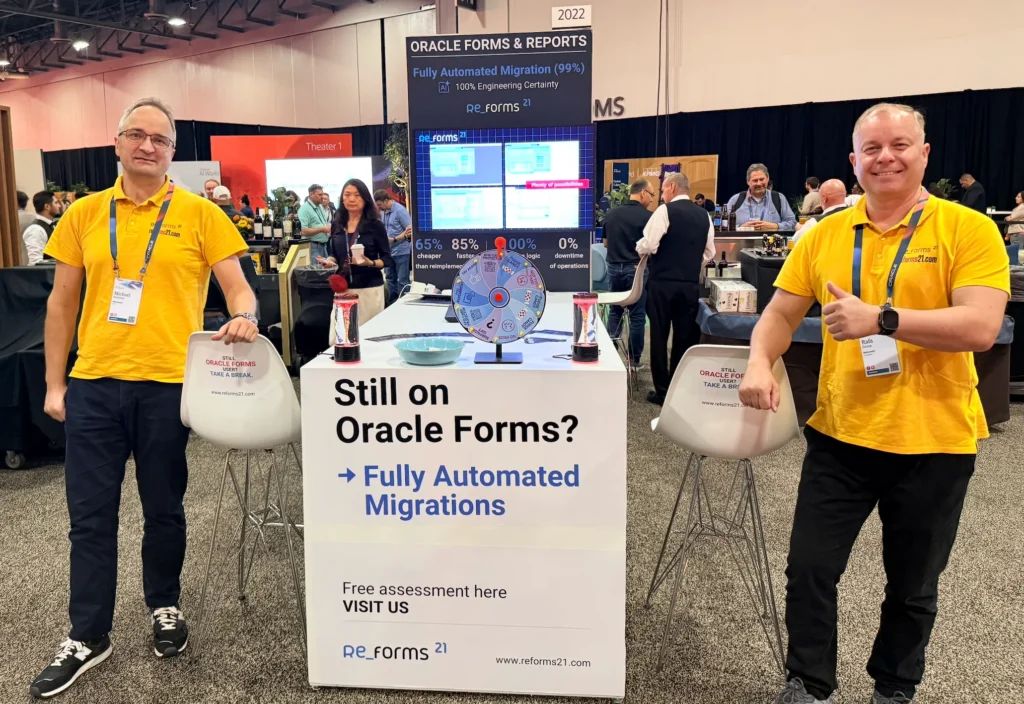
What we heard at the booth
Three observations stand out.
- The question is “how”, not “whether”. Few conversations started with whether to migrate. Most started with how to do it without rewriting decades of business logic from scratch.
- Certainty matters more than speed. Many IT leaders have already seen what AI-generated code does with legacy logic. They are not looking for a faster guess. They want a deterministic transformation they can verify. Our automation averages 99% across more than 22,000 migrated Oracle Forms & Reports objects.
- The US and Latin America are ready to move. Openness to Java and React was highest among organizations from the United States and Latin America. For us, that confirms where demand for truly automated migration is growing.
AI will not solve an Oracle Forms & Reports migration on its own
Oracle AI World was, by design, a conference about what AI can do. At our booth, the more frequent topic was what it cannot do.
General-purpose LLMs are probabilistic, but business logic must be deterministic. Code that looks correct and then handles NULL values or numeric precision differently from the original does not fail loudly. It fails silently, in production. We showed a side-by-side example of exactly that on a selected calculation trigger.
That is why we keep the two roles separate:
- AI supports analysis, modeling and context. ReML builds an digital twin model of the application before any code is generated. After migration, the ReForms Information Base (RIB) gives architecture and dependency context for the entire system.
- The core migration follows deterministic rules. The same input always produces the same output, so every result can be verified, repeated and checked.
This combination is what makes the outcome predictable. AI helps us analyze and classify, but it never quess your logic.
Evidence before a decision
The most useful thing we showed in Las Vegas was not a slide. It was a analysis tool.
The ReForms21 Analyzator Tool runs on your own Oracle Forms & Reports code before you take any decision abuot your system.. Using algorithms and AI-supported analysis, it generates a report that shows:
- Inventory: every FMB, MMB, PLL, OLB and RDF module in your estate
- Dependencies: how modules, libraries and database objects connect and interact with each other
- Automation level: what automated migration will involve, module by module
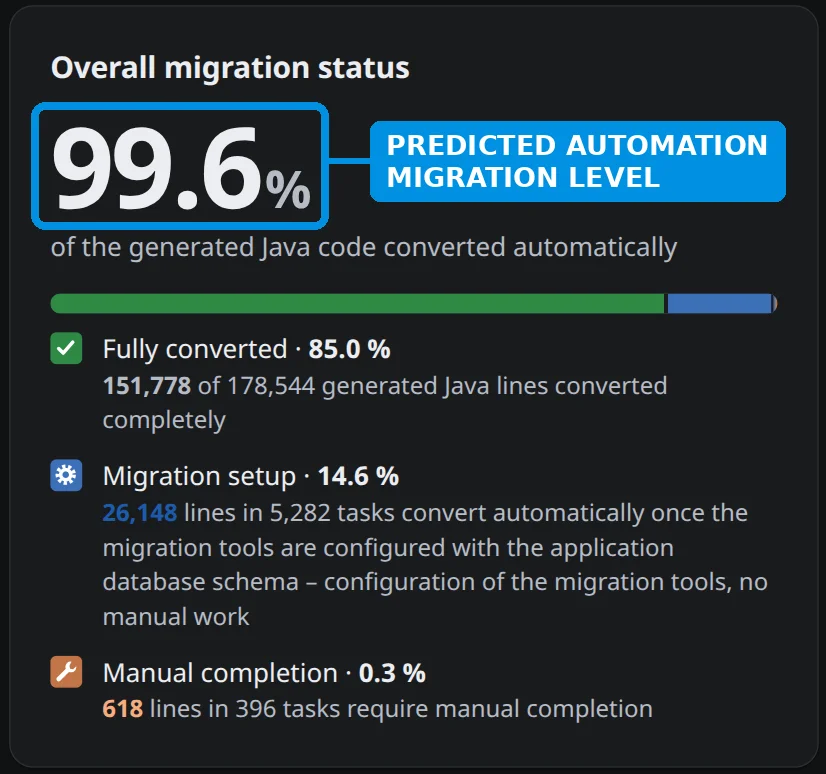
In the sample above, taken from an enterprise migration, 99.6% of the generated Java code was converted automatically. Scope, budget and predicted automation level are then built on measured data from your system, not on an estimate.
Conversations with cloud providers
We also met Microsoft Azure and Google Cloud teams to discuss paths that take migrated applications straight to the cloud, without additional licences.
The logic is simple. Once an Oracle Forms & Reports application becomes a Java/React application, it is a standard workload: REST APIs, containers, CI/CD pipelines, any cloud. The database decision stays separate. Your Oracle Database can stay in place or, as an option, move to PostgreSQL.
What comes next
We are following up with the teams we met in Las Vegas, starting with Analyzator Tool on their own code.
If we did not get the chance to meet
We help organizations migrate Oracle Forms & Reports applications to Java/React automatically, preserving 100% of business logic and UI, with zero downtime of your business operations.
Book a 20-minute walkthrough and we will run the Analyzator engine on Oracle Forms & Reports code and show you what converts automatically and what needs manual work. FAQ: ReForms21 after Oracle AI World 2026
How much of an Oracle Forms & Reports system can be migrated automatically. The ReForms21 Analyzator Tool answers it on your own code, before any decision you might take.
General-purpose LLMs are probabilistic, so they can produce code that looks correct and behaves differently comapring to your own business logic. ReForms21 uses AI for analysis and modeling, and deterministic rules for the migration itself.
Premier Support for Oracle Forms 14c runs until December 2030. Moving to 14c buys time to plan a migration to an open stack.
No. The application layer moves to Java/React while your Oracle Database stays in place. Moving the database to PostgreSQL is an option, not a requirement.
Book a 20-minute walkthrough or and run it on your Oracle Forms & Reports estate.


