


A lot of companies today know that their Oracle Forms and Reports applications, which have been around for a long time, are reliable but often can’t keep up with the demands of a digital world that changes quickly. These systems were made for a time when client-server computing was the norm, but they can feel limiting in today’s web, cloud, and mobile-focused world. Because they use older, proprietary technologies, they often have trouble scaling up, integrating, and coming up with new ideas quickly. Because of this, businesses are looking for more flexible and future-proof options, and Java often comes out on top because it is widely used and can be adapted to many different situations.
The need to modernize these legacy Oracle Forms applications is undeniable. However, navigating the modernization journey presents several key challenges:
- Strategic Choice: Deciding whether to pursue an upgrade within the Oracle ecosystem, such as to Oracle APEX, or to transition to open-source technologies like Java.
- Resource Allocation: Carefully evaluating the investment in terms of costs, personnel, and timelines associated with each modernization approach, including potential licensing fees and development efforts.
- Avoiding Lock-in: The strategic imperative to ensure that the chosen solution offers long-term flexibility and avoids excessive dependency on a single vendor or proprietary stack.
- Ensuring Continuity: Maintaining seamless integration with existing IT infrastructure and ensuring the new solution not only addresses current needs but also supports future strategic goals.
These critical decisions demand a thorough assessment of technological fit, financial implications, and overarching business objectives. While Oracle APEX is often considered a natural choice due to its familiarity within the Oracle environment, it’s crucial to examine whether it truly represents the optimal path, especially when compared to the advantages of migrating to open-source Java using specialized tools like those offered by ReForms21.
Understanding Oracle Application Express (APEX)
Oracle APEX, a low-code development platform, is deeply integrated with the Oracle database. While this offers a degree of familiarity for existing Oracle users, it also presents inherent limitations:
- Ecosystem Dependence: APEX’s tight coupling with the Oracle database inherently limits architectural flexibility, potentially creating a vendor lock-in scenario. This dependency often translates to ongoing and potentially increasing Oracle licensing costs, restricting the freedom to consider alternative database platforms.
- Scalability & Complexity Challenges: While suitable for simpler applications, APEX can face limitations in terms of scalability and performance when confronted with more complex, high-transaction, or enterprise-grade requirements. Addressing these issues may necessitate frequent and costly upgrades.
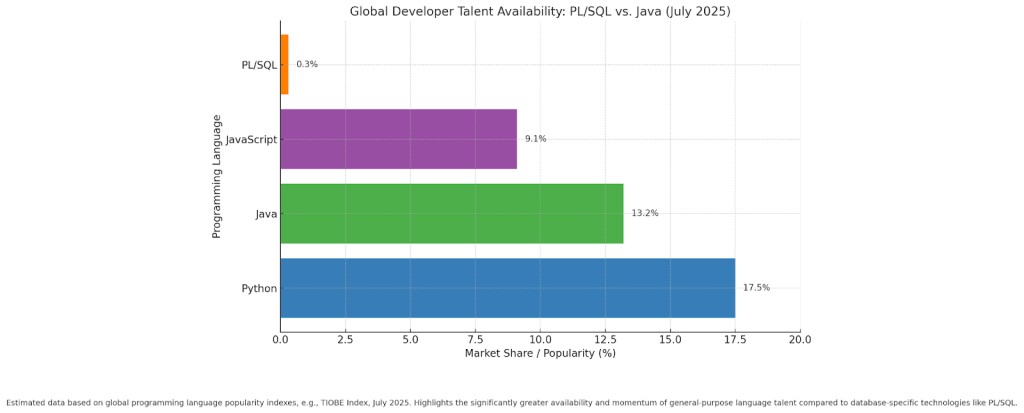
- Talent Pool Constraints: APEX development primarily relies on PL/SQL, a proprietary language. As evidenced by broader industry trends (e.g., the TIOBE Index, which in July 2025 lists Java as a leading programming language globally, while PL/SQL stands at a much lower position with a significantly smaller market share), the talent pool for PL/SQL is considerably smaller and shrinking. This scarcity can make it challenging to find skilled developers, potentially impacting project timelines and increasing labor costs.
The Power of React & Angular: Technical Advantages in Modern Web Development
In stark contrast, modern JavaScript frameworks like React and Angular offer a robust foundation for contemporary web applications. Their widespread adoption is due to several key technical advantages:
- Component-Based Architecture: Both frameworks champion a modular approach, allowing applications to be built from reusable, independent components. This significantly accelerates development cycles and enhances maintainability.
- Optimized Performance: React employs a virtual DOM for efficient rendering, reducing browser load, while Angular utilizes Ahead-of-Time (AOT) compilation to boost application performance by compiling code during the build process.
- Rich Ecosystem & Community: Supported by vast and active communities, React and Angular boast extensive libraries, tools, and plugins. This vibrant ecosystem provides abundant resources for problem-solving, innovation, and continuous improvement.
- Cross-Platform Capabilities: Angular includes native tools for mobile app development, and React extends its reach to mobile with React Native, enabling efficient development across various platforms.
- Scalability & Maintainability: Designed to handle large-scale applications, these frameworks offer robust state management solutions (e.g., Redux for React, NgRx for Angular), ensuring maintainability even for highly complex and dynamic interfaces.
- Enhanced Developer Experience: Features such as TypeScript in Angular and JSX in React provide strong typing and improved code readability, contributing to fewer bugs and more effective team collaboration.
These advantages position React and Angular as ideal choices for building flexible, high-performance, and scalable modern web applications.
The Economic & Strategic Case for Open-Source Java Migration
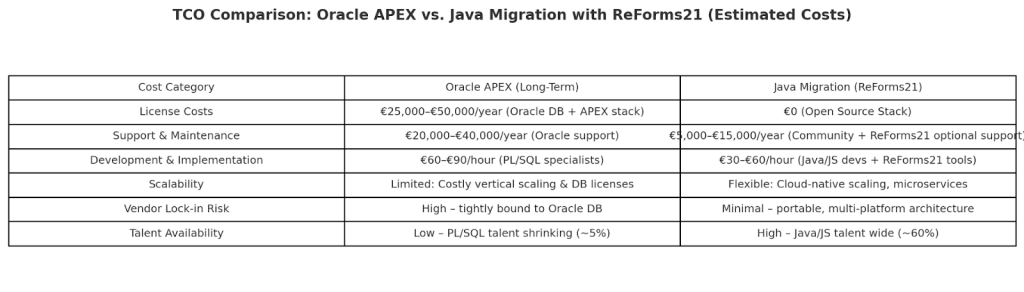
Beyond the technical prowess of modern frontend frameworks like React and Angular, migrating your Oracle Forms applications to an open-source Java backend offers compelling economic and strategic benefits. This approach provides the robust foundation needed to fully leverage those cutting-edge web technologies, creating a truly modern and interconnected application ecosystem:
- Reduced Total Cost of Ownership: Unlike Oracle APEX, which necessitates ongoing Oracle licenses and support costs, a migration to Java using solutions from ReForms21 can substantially lower your total cost of ownership. By reducing or eliminating database dependencies and proprietary vendor lock-in, open-source Java solutions provide more predictable expenses and greater agility to adopt future technologies, including modern frontend frameworks.
- Enhanced Security & Flexibility: While APEX applications are tightly bound to the Oracle database, potentially inheriting its specific vulnerabilities, open-source Java allows for a platform-agnostic approach to security. This empowers organizations to implement a wide array of security tools and best practices across diverse environments, strengthening their overall security posture and compliance. By providing a robust and flexible backend, Java perfectly complements the security and architectural advantages of frontend technologies like React and Angular.
- Future-Proofing & Innovation: Open-source Java offers unparalleled flexibility, integrating seamlessly with modern development paradigms such as microservices architectures, cloud-native deployments, and robust DevOps pipelines. Its cross-platform nature allows applications to run on various operating systems. This versatility makes Java an ideal backend for supporting dynamic, modern frontends built with React or Angular, ensuring long-term sustainability and reduced dependency on specific vendors. It future-proofs your IT landscape against evolving technological trends by creating a truly modular and adaptable application stack.
ReForms21: Your Partner in Digital Evolution with Legacy systems
ReForms21 is your go-to partner for digital transformation. We do not only have the knowledge you need, but also own technology that allows moving Oracle Forms apps to a modern Java codebase. Our cutting-edge solutions are designed to keep your current business logic while completely updating the architecture of the application.
ReForms21 greatly cuts down on the time, effort, and risks that come with manual rewrites by using our unique automation features. Our strong framework works well with modern cloud environments and microservices architectures, making it easy for businesses to move to a more scalable, flexible, and efficient infrastructure. Businesses can modernize their old systems in a cost-effective and very efficient way by using solutions from ReForms21.
Conclusion
For many organizations, simply „upgrading” Oracle Forms and Reports to APEX may not be the ideal long-term strategy. The built-in limitations of APEX — especially its tight integration with the Oracle eco-system — can result in rising expenses, reduced flexibility, and a strong dependence on a single vendor, making it harder to scale or adapt.
In stark contrast, migrating to open-source Java with ReForms21’s specialized tools presents a far more versatile and sustainable solution. This approach liberates organizations from proprietary Oracle constraints, significantly reduces long-term ownership costs, and enhances security through the transparency and collaborative support of the open-source community. With ReForms21, you’re not just transforming your IT landscape; you’re gaining tangible benefits that redefine your operational efficiency and future readiness. Our process ensures an end-to-end migration with minimal team involvement, preserving 100% of your crucial business logic, and maintaining existing application functionality and design. You’ll achieve a vendor-unlocked application with guaranteed long-term maintenance and the power to drive further development using our dedicated „Studio” tool, all underpinned by fully measured correctness at every stage.
By choosing ReForms21, organizations can effectively overcome the scalability and performance challenges often associated with APEX, tap into a broader talent market, and benefit from continuous innovation and updates within the open-source ecosystem. This makes ReForms21 a strategically sound, cost-effective, and future-proof choice for truly modernizing legacy Oracle Forms applications.